
____________ ITW 2026 | DAY 1 READ-THROUGH
FROM AI CAPACITY proof
to ai connectivity proof.
From the floor of ITW Day 2, eight signals — programmable interconnect, east-west AI traffic, observability, automation, direct-to-device satellite, NTN standards, Carrier Ethernet in space, and AI corridors — reshaping how AI-era connectivity gets built, priced, and monetized.
Ai infrastructure is moving from capacity to proof connectivity proof -
advantage now goes to networks that can be programmed, observed, automated, secured, and commerically aligned with ai workload demand.
TW Day 2 reinforced that the AI infrastructure conversation is moving beyond data center capacity alone. The
market is now asking whether AI workloads can be connected, observed, automated, secured, monetized, and
extended across terrestrial, cloud, and non-terrestrial networks.
The strongest Day 2 signals point to a connectivity-led execution phase. Programmable interconnect is moving
from strategy slide to carrier roadmap — Lumen's Alkira acquisition validates that large operators are pursuing
cloud-native control planes for cloud-to-cloud, data-center, and multi-cloud connectivity. At the same time, zero
touch provisioning and self-service NaaS remain unevenly adopted. The market wants cloud-like network
behavior, but telco operating models are still catching up.
Day 2 also surfaced a second pattern: AI workloads are changing the shape of network demand. Traffic is
shifting from north-south access toward east-west, data-center-to-data-center, cloud-to-cloud, and distributed AI
flows. That makes observability, telemetry, asset inventory, and predictive capacity planning more important.
Network value is no longer only in the fiber asset; it sits increasingly in the software layer that makes the asset
visible, programmable, and monetizable.
A third cluster came from satellite and non-terrestrial networks. Direct-to-device satellite is moving from niche
promise toward commercial reality. 3GPP NTN standards are pulling satellite into the mainstream telecom stack,
and satellite operators are increasingly packaging services in telco-native terms — including Layer 2 Carrier
Ethernet and MEF-style commercial models. Satellite is not replacing terrestrial networks; it is becoming an
integrated extension of the global connectivity fabric.

WHAT THE FLOOR IS ACTUALLY SAYING.
Each signal is cross-validated against the broader DCS Signals Engine and tagged for strength (emerging · strengthening · recurring · established). Day 1 surfaced four strengthening signals across power, network, workload, and forecast discipline.
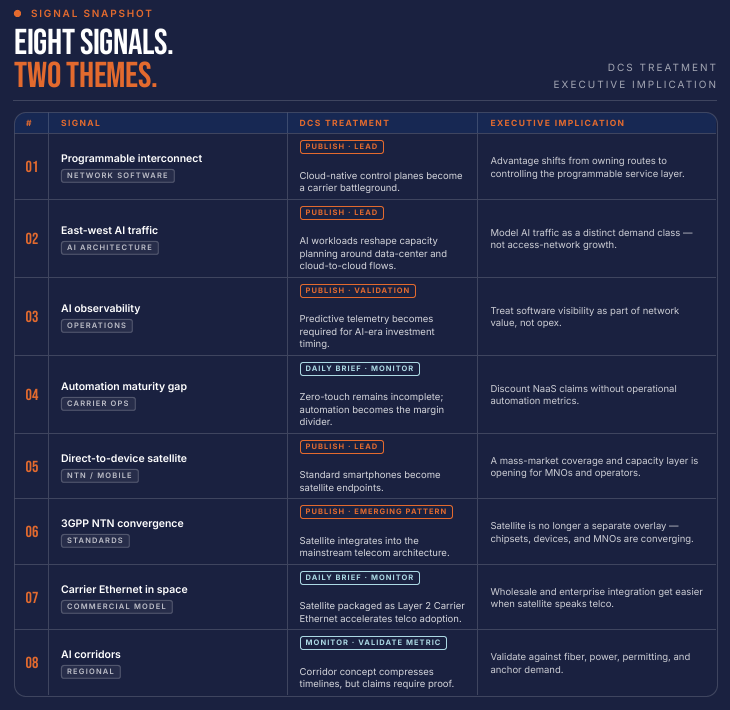
01 pROGRAMMABLE INTERCONNECT BECOMES A CARRIER BATTLEGROUND.
Programmable interconnect is moving from aspiration to strategy. Lumen’s Alkira acquisition and broader platform direction signal that large carriers are building cloud-native control planes to support cloud-to-cloud, data-center, and multi-cloud connectivity.
Context · Why This Matters
AI infrastructure increasingly depends on fast, flexible, policy-aware connectivity across data centers, clouds, and enterprise environments. Static telco provisioning models are mismatched against the speed and variability of AI workload demand. Programmable interconnect gives carriers a way to compete more directly with cloud-native networking platforms and hyperscaler-adjacent services.
Evidence · Sessions & Voices
Global Interconnect session — Gabe Gomez of Lumen described the company’s effort to digitize physical network elements and create a programmable platform, including the Alkira acquisition. The Day 2 validation also confirmed that Lumen publicly positions Alkira as part of a cloud-native Network-as-a-Service control plane for cloud-to-cloud and data-center interconnect.
Implication · What to Watch
The competitive question is shifting from “who owns the fiber?” to “who controls the programmable service layer?” Carriers with strong physical networks but weak orchestration may lose share to providers with superior APIs, cloud integration, and customer-facing control planes.
DCS Treatment
Publish · lead signal. Programmable interconnect should enter the DCS AI connectivity framework as a core requirement for cloud-to-cloud, data-center-to-data-center, and multi-cloud AI workloads.
Market Exposure: Global carriers · Cloud interconnect · Data-center interconnect · Multi-cloud networking · Enterprise AI
02 East-West AI Traffic Reshapes Network Planning
AI Network Architecture
AI workloads are increasing east-west traffic between data centers, clouds, and regions, creating a planning model that differs from traditional north-south user-to-cloud network assumptions.
Context · Why This Matters
Traditional network planning has often centered on access traffic, content delivery, and north-south flows from users to applications. AI workloads are more distributed, more data-intensive, and more likely to require movement between compute clusters, clouds, model providers, enterprise environments, and geographies. This changes where capacity is needed and how networks are designed.
Evidence · Sessions & Voices
Data Talks session — speakers described a major shift from north-south to east-west traffic, with AI workloads communicating between geographies and data egressing from data centers onto networks. This was reinforced by Lumen’s Alkira strategy, which emphasizes east-west cloud-to-cloud and data-center interconnect as a strategic requirement.
Implication · What to Watch
AI traffic should be modeled as a distinct network demand class. Operators should track data-center-to-data-center bandwidth, cloud-to-cloud flows, inter-region latency, route diversity, and optical upgrade requirements separately from traditional access-network growth.
DCS Treatment
Publish · lead signal. East-west AI traffic becomes a core DCS network-readiness indicator for AI infrastructure markets.
Market Exposure: Optical networks · Fiber routes · Subsea systems · Cloud interconnect · AI clusters · Data-center campuses
03 AI Observability Becomes Required for Network Investment Timing
Operations
AI is moving observability from reactive monitoring into predictive planning. Operators need telemetry, asset visibility, and AI-assisted analytics to avoid being late on capacity upgrades.
Context · Why This Matters
AI traffic growth increases the cost of operational blindness. Operators that cannot see asset utilization, traffic flows, dependencies, and capacity pressure early will either overbuild inefficiently or underbuild and miss customer demand. Observability becomes a planning tool, not just a troubleshooting tool.
Evidence · Sessions & Voices
Data Talks session — speakers distinguished monitoring from observability, describing monitoring as reactive and observability as predictive. AI was positioned as operating inside the “observability gap.” The Global Interconnect session also reinforced asset inventory and relationship mapping as foundational for zero-trust and automation.
Implication · What to Watch
The market should track adoption of AI observability, digital twins, asset inventory, and dependency mapping across carriers and network operators. Investors should also treat software visibility as part of network value, not merely an operating expense.
DCS Treatment
Publish · validation signal. Observability should be included in the DCS framework for network investment readiness and AI-era capacity planning.
Market Exposure: Network software · OSS/BSS · AI analytics · Digital twins · Service assurance · Infrastructure investors
04 Automation Maturity Becomes a Margin and Scalability Divider
Carrier Operations
Zero-touch provisioning remains incomplete across the market, but operators with higher automation can quote, provision, and scale services without proportional staff growth.
Context · Why This Matters
The market wants cloud-like network behavior, but many telcos remain constrained by manual provisioning, long lead times, inconsistent visibility, and legacy OSS/BSS. Automation maturity therefore becomes both an operational capability and a commercial differentiator.
Evidence · Sessions & Voices
Global Interconnect speakers described zero-touch provisioning as a journey rather than a completed state. Data Talks speakers referenced Orange’s automation level and fully automated customer workflows at ORCHEST, while also noting that adoption varies widely by region and customer behavior.
Implication · What to Watch
Operators should be evaluated on real automation metrics: quote automation, order automation, provisioning automation, API coverage, mean activation time, and customer portal utilization. “NaaS” claims without operational automation should be discounted.
DCS Treatment
Daily brief · monitor. Automation maturity becomes a comparative operator scorecard, but claims require standardized metrics before stronger publication.
Market Exposure: Telcos · NaaS providers · OSS/BSS vendors · Enterprise connectivity buyers · Infrastructure investors
05 Automation Maturity Becomes a Margin and Scalability Divider
NTN / Mobile
Standard smartphones can increasingly connect directly to satellites without specialized terminals, creating a real commercial category for coverage extension, emergency connectivity, and eventually broader mobile services.
Context · Why This Matters
Direct-to-device satellite changes the boundary between mobile networks and satellite infrastructure. Instead of satellite connectivity requiring specialized terminals, the user’s existing phone becomes the endpoint. This dramatically expands the addressable market and forces MNOs to evaluate satellite as partner, roaming layer, coverage extension, or competitor.
Evidence · Sessions & Voices
Monetising the Mesh session — speakers described the standard smartphone as the terminal and characterized direct-to-device satellite as a real mass-market service generating revenue. External validation supports the broader direction, with major satellite and mobile players positioning direct-to-cell services as an extension of mobile coverage.
Implication · What to Watch
The near-term opportunity is likely emergency messaging, rural coverage, maritime / remote access, and enterprise resilience. The longer-term question is whether capacity and economics can support more data-intensive use cases.
DCS Treatment
Publish · lead signal. Direct-to-device satellite should be elevated as a core DCS network-convergence signal.
Market Exposure: MNOs · Satellite operators · Device OEMs · Spectrum · Rural coverage · Emergency services · Enterprise resilience
06 3GPP NTN Pulls Satellite Into the Mainstream Telecom Stack
Standards
3GPP NTN standards are enabling terrestrial and non-terrestrial networks to converge into a more unified architecture, supporting chipset development, mobile integration, and new service models.
Context · Why This Matters
Satellite has historically operated as a separate connectivity layer. 3GPP NTN changes that by bringing satellite access into the same standards ecosystem that governs mobile networks. This reduces integration friction for devices, operators, chipsets, and network services.
Evidence · Sessions & Voices
Monetising the Mesh session — speakers identified 3GPP NTN as a key driver of unified terrestrial and satellite networks. External standards validation confirms that NTN entered the 3GPP release path and supports satellite access for handheld and IoT use cases.
Implication · What to Watch
The market should distinguish between standards progress and commercial maturity. NTN integration is real, but seamless mobility, handover, capacity, service quality, and device support will mature over time.
DCS Treatment
Publish · emerging pattern. NTN standards should enter the DCS convergence tracker as a key enabling layer for satellite/mobile integration.
Market Exposure: 3GPP ecosystem · Chipsets · MNOs · Satellite operators · Devices · IoT · Coverage extension
07 Satellite Services Are Being Packaged in Telco-Native Commercial Models
Commercial Model
Satellite operators are beginning to package services as Layer 2 Carrier Ethernet, using familiar telco standards, contracts, SLAs, and service language to reduce adoption friction.
Context · Why This Matters
For satellite capacity to scale through telco channels, it must fit into the commercial and operational language carriers already use. Carrier Ethernet packaging gives satellite operators a way to sell capacity in a familiar form, potentially accelerating wholesale adoption and enterprise integration.
Evidence · Sessions & Voices
Monetising the Mesh session — speakers described Layer 2 Carrier Ethernet in space, MEF-style alignment, and contracts that look like terrestrial Ethernet deals. Telesat’s Lightspeed positioning provides external support for this model.
Implication · What to Watch
The important question is whether this becomes a broader LEO market pattern or remains concentrated among specific wholesale-oriented providers. Adoption across multiple operators would strengthen the signal.
DCS Treatment
Daily brief · monitor. Treat Carrier Ethernet in space as a commercial-integration signal within the broader satellite-terrestrial convergence theme.
Market Exposure: LEO networks · Wholesale carriers · MEF ecosystem · Enterprise networking · MNO partnerships · Satellite backhaul
08 AI Corridors Are an Emerging Regional Infrastructure Thesis — Not Yet a Validated Category
Regional Infrastructure
AI corridors propose a linear model of low-latency optical transport, modular data centers, and power infrastructure, but current claims require validation before they can be treated as investable signals.
Context · Why This Matters
The AI corridor concept is interesting because it attempts to solve multiple constraints at once: latency, fiber access, modular deployment, community impact, and regional economic development. If validated, it could become a repeatable model for regional AI infrastructure buildout outside traditional data-center hubs.
Evidence · Sessions & Voices
Rise of the AI Corridor session — speakers described Project Einstein in Pennsylvania as a potential near-term deployment using existing dark fiber and minimal permitting. They also positioned AI corridors as economic-development infrastructure. However, aggressive claims around eight-month deployment, lunar corridors, and policy-capital catalysts require further proof.
Implication · What to Watch
The terrestrial corridor thesis should be validated against physical execution: fiber rights, power availability, land control, permitting, modular data-center procurement, anchor customers, and financing. Without these, “AI corridor” risks becoming branding rather than a distinct infrastructure category.
DCS Treatment
Monitor · validate metric. Do not publish as a lead signal yet. Track AI corridors as an emerging regional infrastructure thesis pending project-level confirmation.
Market Exposure: Regional AI infrastructure · Dark fiber · Modular data centers · State economic development · Optical transport · Edge compute
WHAT TO DO ON MONDAY.
THREE AUDIENCES
TWENTY-SIX MOVES

+ Reassess whether network
products can support
programmable, cloud-like
customer behavior.
+Identify which interconnect assets
can be exposed through APIs, portals, or programmable control
planes.
+Separate true zero-touch
capability from partially
automated sales and provisioning
workflows.
+ Build east-west AI traffic
assumptions into capacity
planning, not only access or
enterprise WAN growth.
+ Prioritize telemetry, asset inventory, dependency mapping,
and observability as infrastructure value drivers.
+Evaluate whether data-center, cloud, and network offerings can support distributed inference and
multi-cloud AI workloads.
+ Track whether satellite can extend service footprints in rural, remote, maritime, defense, and
resilience use cases.
+ Treat NTN and direct-to-device as near-term strategic inputs, not
long-range science projects.

+ Ask whether connectivity
providers can provision, modify, monitor, and secure capacity within AI deployment windows.
+ Evaluate interconnect providers on API maturity, observability, route diversity, cloud integration, and automation depth.
+ Model AI traffic flows separately: training, inference, cloud-to
cloud, DCI, edge, and backup /resilience.
+ Do not assume NaaS portals equal actual self-service adoption or faster activation.
+ Assess whether satellite services can provide resilience, remote
coverage, or backup connectivity for critical operations.
+ Evaluate direct-to-device satellite
by use case: emergency
messaging, remote access, IoT, enterprise continuity, mobile
extension.
+ Treat security and zero-trust integration as part of connectivity architecture, not an optional overlay.
Require evidence of operational automation, not only roadmap claims.

+ Value network assets by software capability as well as physical footprint.
+ Prioritize carriers and platforms with programmable interconnect, observability, automation, and cloud-native control planes.
+ Discount NaaS claims where customer adoption, automation KPIs, and portal utilization are weak.
+ Track M&A opportunities in AI observability, OSS/BSS modernization, service orchestration, and network automation.
+ Evaluate direct-to-device satellite as a real commercial market, but pressure-test capacity, spectrum, pricing, and regulatory assumptions.
+ Watch for ground-station-as-a-service and Carrier Ethernet-in-space models as emerging satellite infrastructure plays.
+ Treat AI corridor claims cautiously until fiber, power, permitting, and customer evidence is confirmed.
+ Avoid over-crediting speculative lunar or off-earth compute narratives without procurement and funding validation.
A CONNECTIVITY-LED PHASE.
AI infrastructure has entered a connectivity-led phase. Demand remains strong, but the next market advantage will depend on whether workloads can be connected, observed, automated, secured, and monetized across cloud, data-center, terrestrial, and satellite networks.

AI INFRASTRUCTURE IS NO LONGER ONLY A DATA-CENTER BUILDOUT STORY - IT IS BECOMING A NETWORK OPERATING-MONDEL STORY.
the winners make connectivity programmable, observable, automated, secure, and flexible — while integrating terrestrial, cloud, and satellite networks into a usable AI-era fabric.
Couldn't make all the sessions?
DCS identifies market shifts, emerging constraints, and where infrastructure decisions are moving next so your business can act with greater clarity. Check out Day 02 Instant Signals.